

The BIPVco Renewable Energy Jargon Buster: Helping You Cut Through the Solar Speak
The world of renewable energy can be full of impressive acronyms and technical phrases. But we get it, not everyone speaks ‘solar’.
At BIPVco, we make building-integrated photovoltaics (BIPV) simple, seamless, and sustainable. Whether you’re an architect, specifier, contractor or curious building owner, this jargon buster will help you feel confident as you explore solar solutions.
Below is part one of the Jargon Buster terms that are commonly found in our industry and beyond!
Got questions? Get in touch. We’re happy to talk solar (without the jargon).
Solar systems that complement, rather than compromise building design.
Solar Panels installed on top of existing building surfaces.
Systems that store surplus solar energy for later use.
Solar Modules Designed to be a part of the building envelope, such as roofs or facades.
The highest UK Fire safety classification for roofing systems, met by BIPVco Products.
Electrical components that protect solar modules by redirecting current around shaded or faulty cells.
The total amount of greenhouse gases emitted directly or indirectly by a person, building or process.
Balancing emitted carbon with carbon savings or offsets to achieve a net-zero carbon impact.
Going beyond carbon neutrality by removing more CO2 than is emitted – often through renewable generation and offsetting.
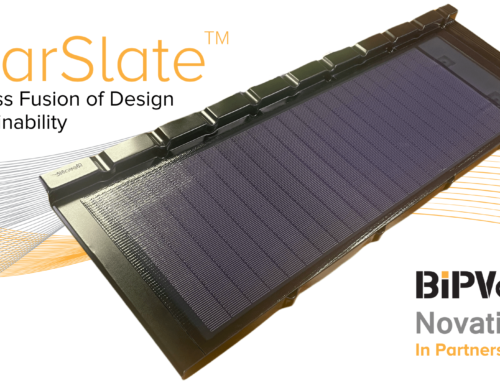
Thin-film, Flexible solar cell technology used in BIPVco Modules.
The Long-Term Alteration of global weather patterns, largely driven by greenhouse gas emissions from human activity, solar helps mitigate its effects by reducing on fossil fuels.
A company’s commitment to ethical, social and environmental sustainability goals.
Current Flowing at module’s peak output point.
The percentage of sunlight converted to usable electricity.
Devices that convert DC from Solar modules into AC for Building use and grid export.
The Measure of solar energy received on a surface, affecting performance.
Unit of energy used to measure electricity consumption and production.
Maximum rated output of a solar system under STC.
The point at which voltage and current combine to yield the most power.
UK Quality assurance for solar products and installers, ensuring performance and safety.
The Localised air layer between a panel and the roof surface; can affect cooling and output.
Solar technology integrated into vehicles and mobile platforms for on-the-go power.
A building or business that generates as much energy as it consumes over a year.
Maximum voltage a solar module produces when not connected to a load.
The technology that converts sunlight into electricity using semiconductor materials.
Adding new technologies to existing structures, such as BIPV solar.
Lab Test Conditions (1000W/m² Irradiance, 25ºC cell temp) used to standardize solar performance ratings.
Current produced when module output terminals are directly connected.
Balancing energy security, affordability, and environmental sustainability, BIPV Supports all three.
The national or regional electricity supply network.
Voltage at which a module produces its maximum power output.